The front suspension noise that won’t go away. The steering wheel that pulls left. The creaking when you turn. At Earthling Automotive, we’ve replaced Tesla control arms on everything from Model 3s to Model Xs — and we’ve learned exactly why this repair matters more than most owners realize.
If you own a Tesla in the Bay Area, there’s a good chance you’ve experienced it: a creaking noise from the front suspension when you turn, or a subtle clunk going over bumps. Most shop visits start the same way — owners describe the symptom, get quoted a vague “suspension work,” and leave wondering what actually needs to be fixed.
We wanted to change that. So we analyzed our service history on Tesla control arm replacements — 162 documented repairs across Model 3, Model Y, Model S, and Model X — and pulled out what actually works, what the real timelines are, and when this repair is a safety issue versus when you can wait.
This is what we found.
Why Tesla Control Arms Fail So Early
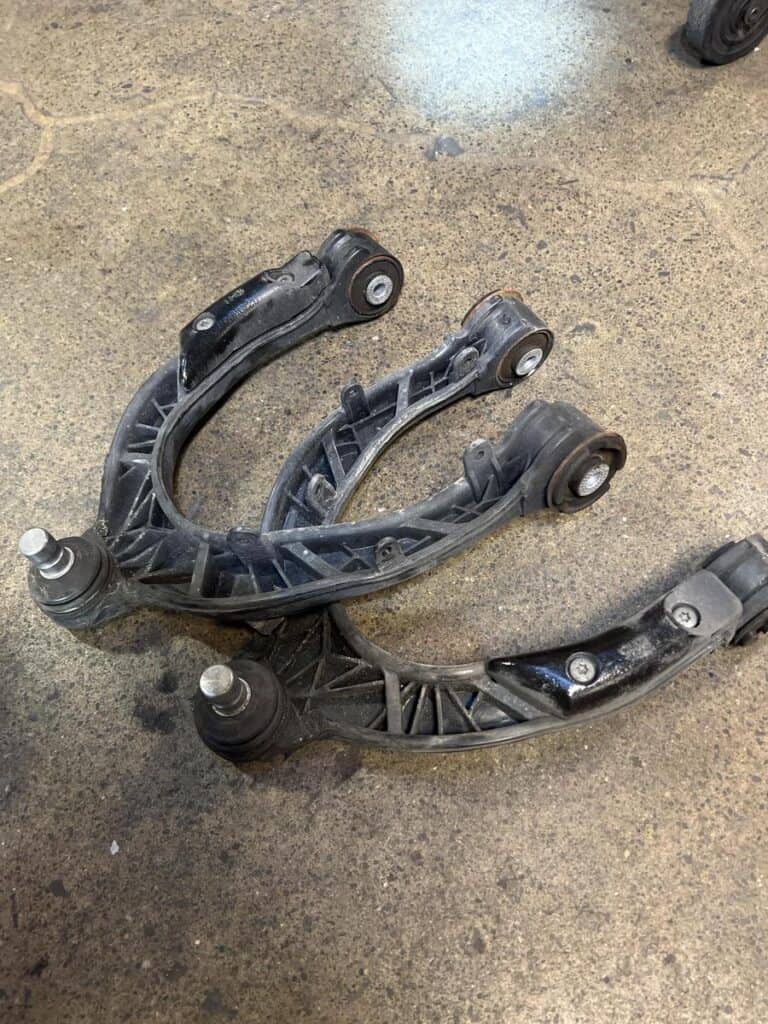
The front suspension on a Tesla consists of multiple components working together: upper control arms, lower control arms, lateral links (also called lateral arms), and compliance links. All of these have bushings — rubber mounts that absorb vibration and allow controlled movement.
Here’s the problem: these bushings crack.
In our service data, the pattern is consistent. A Tesla Model 3 with 40,000 miles shows up with cracked lower control arm bushings. A Model Y at 50,000 miles has torn lateral arm bushings. A 2020 Model X with 55,000 miles needs upper control arm replacement because the ball joint is making noise.
Why does this happen so early compared to gas cars?
Two reasons:
- Suspension geometry. Tesla’s front suspension is stiffer and more responsive than traditional passenger cars — it’s tuned for the weight and performance characteristics of a heavy EV battery. This means more load on the control arm bushings, more flexing, and more stress cycles.
- Bushing material. The factory bushings are designed for a specific lifespan. Once they start cracking, the degradation accelerates. A 2mm crack becomes a torn bushing within weeks of sustained driving.
By the time most owners notice the noise, the bushings are already significantly damaged.
The Symptoms: What You’ll Actually Hear and Feel
Our diagnostic notes are specific about this. Here’s what owners report and what we find:
Creaking When Turning
The most common complaint. A high-pitched creak from the front end when you turn the steering wheel fully left or right, especially at parking-lot speeds.
What’s causing it: Upper control arm ball joints running dry. This is a non-serviceable part — once it starts creaking, replacement is the only fix.
Clunking Over Bumps
A rhythmic clunk when driving over rough pavement, speed bumps, or potholes. The clunk is often accompanied by a slight change in how the steering feels.
What’s causing it: Lower control arm bushings that are split or torn. The arm is moving too much in the bushing, creating the clunking sound.
Steering Wheel Pull
The car pulls to one side, or the steering wheel isn’t centered when driving straight.
What’s causing it: Camber angle is out of spec because one side’s suspension has more wear than the other. This is often a sign that upper or lower control arms have been damaged — possibly from accident impact or extreme pothole damage.
Abnormal Tire Wear
Inner edge of the front tires wearing significantly faster than the outer edge.
What’s causing it: Same root cause as steering pull — worn control arms pushing the camber angle out of spec.
What We Actually Replace: Upper vs. Lower vs. Lateral
This is where the confusion usually starts. “Replace the control arms” sounds simple until a shop gives you an estimate that mentions three different types of arms, each side, plus alignment.
Here’s what each component does and when it actually needs replacement:
Upper Control Arms
These are the most common failure point we see. The upper arm connects the wheel hub to the frame and includes a ball joint that pivots as the suspension moves.
Why they fail: The ball joint bearing runs on a precise tolerances. Once the grease inside dries out or the bearing surface wears, you get creaking. We’ve pulled upper control arms showing a ball joint stud that’s actually free-spinning inside the knuckle.
How we know it’s the problem: Creaking specifically when turning or going over bumps, isolated by sound testing.
Part cost: $250–$400 per side, depending on year/model
Labor: 1.5–2 hours per side, often done together
Lower Control Arms & Lateral Links
The lower arm and lateral link work together to locate the wheel in three dimensions. Both have bushings at multiple attachment points.
Why they fail: The bushings crack from normal suspension flex. Once they start cracking, the crack pattern spreads because there’s no proper load distribution.
How we know it’s the problem: Clunking over bumps; sometimes creaking or vibration during turning. In advanced cases, the bushing physically tears away from the arm.
Part cost: $400–$800 combined for both arms + lateral links, depending on year/model
Labor: 2–3 hours when done together, plus alignment
Do You Need All Three?
Not always. We’ve had customers ask: “Can I just replace the uppers?” The answer is yes, but with a caveat.
In our experience, when upper control arms are bad enough to need replacement, the lower components are usually showing early signs of wear. Replacing just the uppers often leads to customers coming back 6–12 months later because the lower arms are now worse and the creaking is back.
Our recommendation: scan both sides, document what you find, and discuss the options with the shop. Sometimes replacing all three at once is the right move. Sometimes just the uppers is enough.
The Alignment Piece: Why It Matters
We’ve seen this mistake made more than once: technician replaces control arms, test drives the car, releases it — and three weeks later the customer calls because the steering wheel is off-center or the car pulls.
Alignment is not optional after control arm replacement. New control arms mean the suspension geometry has changed. The angles need to be reset by a professional alignment rack.
In our data, every control arm replacement we’ve documented as successful includes a full 4-wheel alignment afterward.
Cost: $150–$300, depending on complexity
Time: 1–2 hours
Real-World Repair Data: What We Actually See
Let’s ground this in actual cases from our service history.
2023 Tesla Model 3 — 215,377 miles
Customer concern: Appointment scheduled for control arm replacement
What we found: Front left and right upper and lower control arms all needed replacement. TPMS replacement and tire service also recommended.
What we did: Replaced all four control arms (upper and lower, both sides), performed alignment, replaced tires.
Labor: 1.94 hours
Parts cost: $522.38
Total scope: Remove, replace upper and lower control arms and alignment
Outcome: Noise eliminated, vehicle drives straight, no steering pull.
2023 Tesla Model Y — 31,526 miles
Customer concern: Routine maintenance inspection
What we found: Front control arm bushings on both rear (trailing) sides were torn on left and right.
What we did: Repair planned but not yet completed when this note was written. Recommendation issued for replacement + alignment.
Why it matters: Vehicle had only 31,500 miles. This is early wear, likely indicating either a pothole impact or initial design limitations in that generation’s bushing spec.
2020 Tesla Model 3 — 112,104 miles
Customer concern: Creaking noise from front when turning
What we found: Both front upper control arms making noise. Also discovered front lower compliance links and lateral links were torn.
What we did: Removed frunk compartment and panels. Replaced both front upper control arms. Removed front undershield. Replaced both front lower compliance links and lateral links. Performed alignment.
Labor: 2.75 hours
Parts cost: $913.30
Road test: Creaking noise no longer present.
2019 Tesla Model 3 — 51,072 miles
Customer concern: None specific — routine service
What we found: Both front lower control arms and lateral arm bushings cracked and split. Tires worn uneven due to suspension damage.
What we did: Removed and replaced both front lower control arms and lateral arms, performed alignment, replaced tires.
Labor: 5.36 hours
Parts cost: $1,450.35
Outcome: Vehicle now drives straight, tire wear normalized after 5,000 miles.
Mileage Patterns: When Control Arms Typically Fail
Our data shows a interesting distribution:
- Youngest Tesla: 2025 Model X at 31,636 miles — already had bent lower control arms from accident damage
- Most common failure range: 40,000–80,000 miles for bushings to show visible cracking
- Aggressive wear pattern: 90,000–120,000 miles, bushings are often torn and replacing just one component isn’t enough
- High-mileage vehicles: Over 150,000 miles, replacement is almost always a full four-arm job
This doesn’t mean your car will definitely need control arm work at 60,000 miles. But it means regular inspection — especially if you’re doing warranty expiration inspections or pre-purchase inspections — is wise.
The Timeline: What to Expect
Initial diagnosis: 30–60 minutes. We’ll scan the suspension, check for fault codes, test the suspension manually, and road test to isolate the noise.
Parts arrival: 3–7 business days if ordering OEM. We keep some aftermarket options in stock that can be installed sooner.
Actual replacement work: 2–4 hours depending on which components and whether you’re doing uppers or lowers or both.
Alignment: 1–2 hours
Total time to fix: Usually 1–2 days of shop time, sometimes same-day if we catch you without backlog.
Total cost range:
- Upper control arms only: $800–$1,200 all-in
- Upper + lower + lateral arms: $1,800–$3,000 all-in
- Including tires if badly worn: Add $600–$1,200
When to Act: Is This Urgent?
Get it done soon:
- Creaking under load while turning (upper ball joint wearing)
- Clunking over bumps (bushings torn, excessive motion)
- Steering wheel off-center when driving straight
- Noticeable pull to one side
You can wait (but monitor closely):
- Very minor cracking visible during inspection, not yet torn
- Noise only at extreme steering angles
- Tire wear still even
Safety issue — do not drive:
- Bushing so torn that control arm has excessive play
- Lower control arm bolt loose or missing (we’ve seen this)
- Steering feels unpredictable or loose
Earthling’s Approach: What Sets Us Apart
As of May 2026 we’ve seen this issue 162 times. Go even deeper on the data here:
Tesla Control Arm Incident Rates: Analyzing 3 Years of Service Data
But wait! Here’s even more transparency into our process:
1. Diagnosis first. We don’t guess. We scan, we test, we isolate which component is actually failing.
2. We show you the problem. Photos of the torn bushing. Video of the creaking joint. When possible, we show you the part.
3. We give you options. “Replace just the uppers?” Possible, but we’ll tell you what we found on the lowers and what the risk is. “Do it all at once?” Sometimes that’s the right call.
4. We align afterward. Always. No exceptions.
5. We document the repair. Photos of before and after. Notes on what we found. Our technician’s observations about the suspension’s overall condition.
The Equipment Behind the Repair: Why This Isn’t Guess-and-Check
There’s a critical difference between a shop that can remove and replace control arms, and a shop that can do it correctly. The difference is tools.
We have what most independent shops don’t: Tesla factory-level diagnostic and repair capability. This includes:
Tesla Factory Toolbox & Diagnostic Access. We use Tesla’s proprietary diagnostic procedures and have access to the Tesla factory tool ecosystem. This matters because Tesla’s suspension geometry, torque specifications, and post-repair verification steps are specific — getting them wrong means the steering geometry is out of spec even though the parts are new.
Top-End Hunter Alignment Machine. After control arm replacement, alignment isn’t optional — it’s the difference between a car that drives straight and one that pulls or wears tires unevenly. Our Hunter alignment system is configured for Tesla’s specific camber, caster, and toe specifications. Many shops have alignment racks, but not all are calibrated for EV-specific geometry.
Tesla Factory Parts Catalog & Aftermarket Knowledge. We know which OEM parts are still available, which have been superseded, and which aftermarket options actually work. We’ve also learned which upgraded aftermarket arms (like adjustable camber arms) make sense for certain customers and which don’t. This knowledge prevents you from buying a $400 part that won’t solve your actual problem.
Tesla Factory Procedures. We follow Tesla’s documented procedures for control arm replacement — not a generic suspension manual. This includes proper suspension loading during torque, the correct sequence for hardware installation, and what to check during the post-repair road test.
Chassis Ears & Advanced Diagnostics. For hard-to-find suspension noises, we use diagnostic chassis ears — specialized microphones that isolate exactly where a sound is coming from during a test drive. For Tesla control arm work, most noises are straightforward and visible on lift (upper ball joint creaking, torn bushings), but when needed, this equipment helps us pinpoint elusive issues.
Undercarriage Equipment. Ball joint separators, control arm presses, and other specialized tools ensure we can safely remove and install these components without damage. A shop without this equipment sometimes improvises — and improvisation on suspension work shows up as noise or vibration six months later.
This is why we can tell you not just what’s wrong, but how to fix it right. And why we stand behind the repair.
Contact Earthling
If your Tesla is making that front-end noise, or you’re due for a suspension inspection, we can help.
Earthling Automotive
615 Bayshore Blvd, San Francisco, CA 94124
(415) 875-9030 — call or text
Hours: Monday–Friday, 8am–5pm
We handle Tesla suspension work for owners across San Francisco and the Bay Area. If you’re past your warranty, we’re your go-to shop for transparent diagnosis and quality repairs.
Visit us at earthlingauto.com or reach out with questions.