
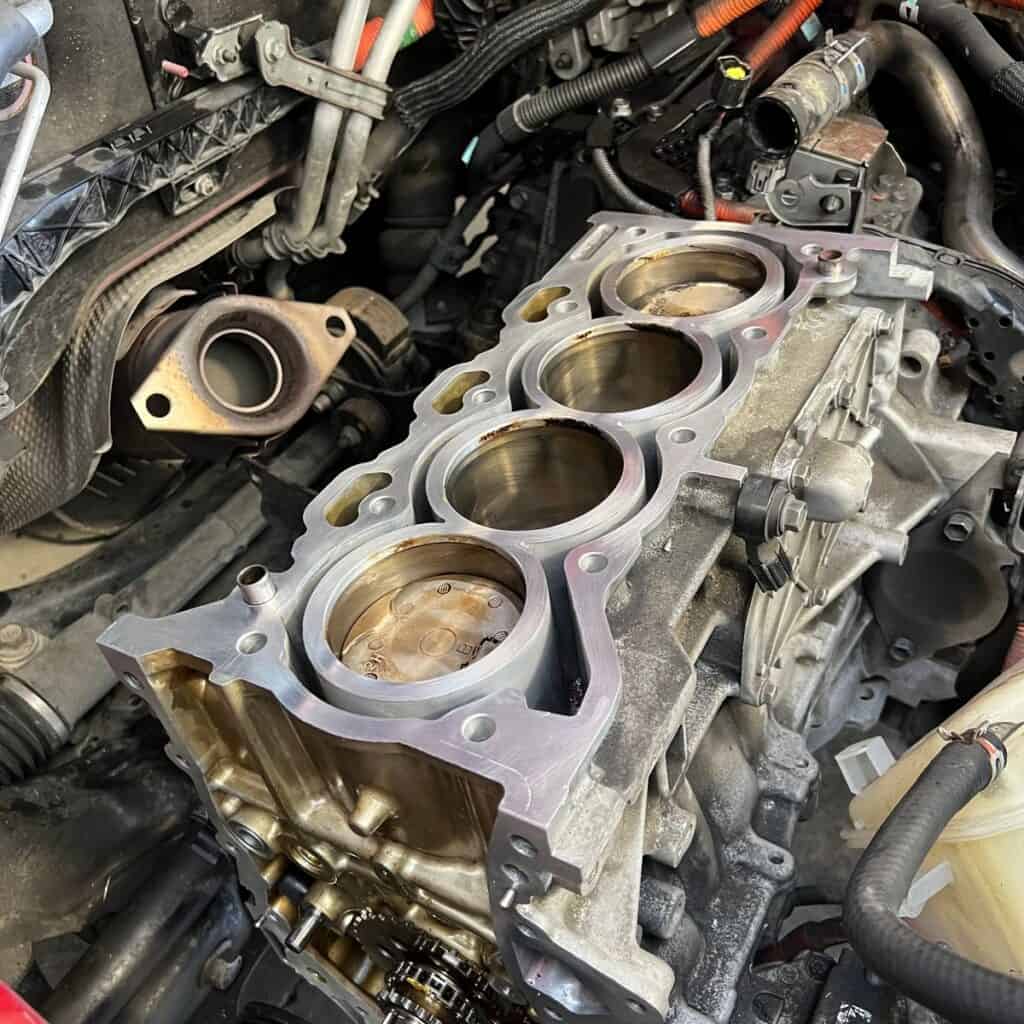
If you own a 2010–2015 Toyota Prius, a 2012 Lexus CT200h, or any of the Prius V or Prius Plug-In variants built around the 2ZR-FXE 1.8-liter engine, this post is written for you.
We’ve been servicing Prius vehicles at Earthling Automotive (and previously Luscious Garage) since 2007. In that time, we’ve accumulated 8,791 repair orders on third-generation Prius and CT200h vehicles across our two San Francisco shops. Of those, 314 involved technician notes that explicitly mention head gasket — the result of actual diagnostic work, not speculation. We’ve replaced head gaskets, replaced engines, and refined our approach based on what we learned from the cars that came back with unexpected problems.
We want to share what the data and our experience tell us.
We Saw This Coming — Earlier Than Most
Earthling has specialized in Prius since the second generation. When the Gen 3 arrived in 2010 with its new 1.8-liter engine, we were already deeply familiar with the platform.
Between 2010 and 2015, we serviced a large taxi fleet in San Francisco. These vehicles ran overnight, seven nights a week — often 20 or more hours a day under sustained load and thermal cycling that most passenger cars never see. Within 18 months of these cars leaving the dealership, we started seeing head gasket failures.
That early visibility gave us a head start on understanding what this engine does under stress, and why the failures happen the way they do.
The Distribution Across Four Shops
To contextualize our experience, we collaborated with Travis at Atomic Auto in Portland, Oregon, and two other independent hybrid specialists to pool repair data. Across the four shops, we identified 235 confirmed head gasket failures on 2010–2016 Gen 3 Prius and CT200h vehicles with valid odometer readings.
Here’s the distribution:
Mileage at time of confirmed head gasket failure (235 cases, 4 shops):
| Mileage Range | Count | % of Total |
|---|---|---|
| Under 100,000 mi | 27 | 11% |
| 100,000–125,000 mi | 23 | 10% |
| 125,000–150,000 mi | 34 | 14% |
| 150,000–175,000 mi | 38 | 16% |
| 175,000–200,000 mi | 46 | 20% |
| 200,000–225,000 mi | 24 | 10% |
| 225,000–250,000 mi | 21 | 9% |
| 250,000–300,000 mi | 12 | 5% |
| Over 300,000 mi | 10 | 4% |
| Statistic | Mileage |
|---|---|
| Average | 173,191 mi |
| Median | 171,777 mi |
| 10th percentile | 95,586 mi |
| 25th percentile | 130,278 mi |
| 75th percentile | 209,961 mi |
| 90th percentile | 248,410 mi |
The peak failure window is 150,000–200,000 miles, where 36% of confirmed cases occurred. But the 10th percentile at 95,000 miles tells us roughly one in ten failures happened before 100k — this is not solely a high-mileage issue.
Earthling’s own data — 314 head gasket–related repair orders — shows an average of 166,000 miles and median of 169,000 miles, closely aligned with the four-shop dataset.
How Our Approach Changed
Our method for addressing this repair has evolved through three distinct phases, each prompted by what we learned from cars that came back.
Phase 1: Head gasket replacement. When we first encountered these failures, we replaced the gaskets. It worked — for a while. Then we saw a secondary failure mode we hadn’t anticipated: bent connecting rods.
Here’s what happens: when a head gasket fails, coolant enters the combustion chamber. A driver who continues operating the vehicle — not knowing what’s wrong — can accumulate enough coolant in the cylinder that when the piston reaches top dead center, it has nowhere to go. Coolant doesn’t compress. The rod bends. We caught some of these by checking piston travel against deck height during teardown, but not all. A car that looked like a clean gasket job would come back with internal damage we hadn’t predicted. That wasn’t acceptable.
Phase 2: Used engine replacement. We shifted to replacing the engine entirely with used units. For a period, this worked well. But as the Gen 3 fleet aged globally, the supply of used engines became inconsistent — unknown history, variable reliability. The value proposition deteriorated.
Phase 3: New short block rebuilds. We tried sourcing new short blocks from Toyota. Mechanically sound, but expensive — often more than the repair warranted for a vehicle of this age and value.
Where we are now: head gasket replacement, with a refined diagnostic protocol. The difference is in how we confirm the diagnosis before committing to any repair path.
How We Diagnose It Now
Getting the diagnosis right is arguably more important than the repair itself.
First, you don’t want to spend money on a head gasket job if you don’t have a bad head gasket.
Second, the Gen 3 Prius also leaks coolant from the EGR cooler — a substantially less expensive repair — and that failure produces nearly identical symptoms: disappearing coolant, no visible external leak, sometimes white exhaust smoke. Head gasket failure is so well-known on these cars it often gets blamed first, which can cost the customer real money if the actual problem is the cooler. Third, we see inexperienced technicians encounter cold-start misfires and reach for spark plugs and ignition coils. The parts get replaced, the bill gets paid, and the underlying coolant intrusion problem is completely untouched.
Originally, we relied on borescope inspection and a block tester — a chemical test that changes color in the presence of combustion gases in the coolant. Both have interpretive uncertainty. Borescope findings require judgment calls. Block test color changes can be ambiguous. Critically, neither test reliably distinguishes between a head gasket leak and an EGR cooler leak — both can contaminate the coolant with combustion gases.
Today, we confirm head gasket failure through pressure testing the cooling system — with actual physical confirmation, not just a gauge reading.
We pressurize the cooling system and leave the vehicle overnight if needed. We’re looking for one thing: the presence of coolant where it shouldn’t be. If coolant is entering the combustion chamber through a failed head gasket, pressure will push it there and it will be visible. If the leak is at the EGR cooler, pressure will locate it there. No color change to interpret, no borescope image to debate. It’s either there or it isn’t — and we know exactly where.
This approach takes longer. It’s also more reliable, and it protects the customer from misdiagnosis in either direction.
What the Data Suggests
We want to start this section with a specific symptom, because it’s the most important early warning.
If your Gen 3 Prius shakes or rattles on a cold start — and then settles down after 10 to 15 seconds — bring it in immediately. Don’t wait for the next service. Don’t see if it happens again. Bring it in.
Here’s what’s happening. When a head gasket is leaking, coolant seeps into the combustion chamber while the engine sits overnight. Cold metal contracts, opening the leak path. When you start the car cold, coolant in the cylinder doesn’t compress. The engine misfires on that cylinder — sometimes violently — until the coolant is combusted and pushed out through the exhaust. That’s why the shaking stops after 10 or 15 seconds. The engine isn’t healing itself. It just ran out of coolant to misfire on.
When the engine is warm, the metal expands, the leak path tightens, and the symptom often disappears entirely. That’s why many owners don’t connect the cold-start rough idle to a cooling system problem — by the time they’ve driven a few miles, everything seems normal. It isn’t.
The risk is this: if enough coolant accumulates in the cylinder — because the leak has grown, because the car sat for a long time, or because someone kept driving through it — the piston hits the coolant at top dead center and the rod bends. At that point you don’t have a head gasket problem anymore. You have an engine replacement. The margin between those two outcomes is miles, not months.
The data across our shops suggests that head gasket failure on the 2ZR-FXE is now a known, common failure mode affecting a substantial portion of the Gen 3 Prius fleet as these vehicles age into the 130,000–200,000 mile range. The Gen 3 remains an excellent car — fuel-efficient, reliable in most other respects, and cost-effective to own. But the head gasket is a known chapter in its story, and preparing for it serves you better than pretending it doesn’t exist.
What to Monitor Now
- Cold-start shaking: Rough idle or misfiring on a cold start that clears within 10–15 seconds is the most important early warning sign. Don’t ignore it.
- Your mileage: If you’re approaching 130,000 miles, start checking coolant level monthly.
- Coolant loss without visible leaks: If your reservoir drops between services with no external leak, that’s worth investigating — not topping off and ignoring.
- Correct diagnosis first: Cold-start misfires on these cars are a cooling system problem, not an ignition problem. If a shop recommends spark plugs or coils without investigating coolant intrusion, get a second opinion.
- Don’t drive through it: The difference between a head gasket job and a bent rod — or a totaled engine — is often just miles.
We’re Here When You Need Us
Earthling Automotive has been working on these cars longer than almost anyone in the Bay Area. We’ve made mistakes on this repair, learned from them, and built a process we trust. If you’re noticing symptoms, have questions about your specific vehicle, or want to understand where your car stands, we’re easy to reach.
You can call or text us at (415) 875-9030. We’re at 615 Bayshore Blvd in San Francisco, Monday through Friday, 8am to 5pm, and you can always reach us at earthlingauto.com.