If you own a Tesla Model S, you know that the door handles are more complicated than they like to suggest. Despite their early elegance and charm, they’re motorized, electronic, and therefore prone to failure, sometimes in surprising ways.
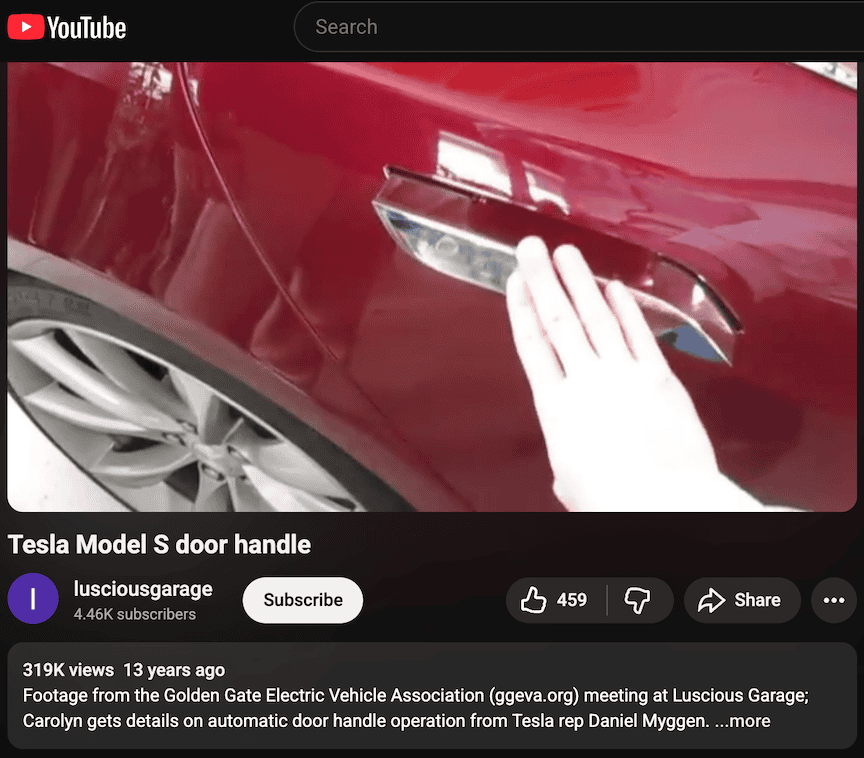
We’ve been watching this issue since the beginning. When the Model S first arrived in the Bay Area, Earthling’s founder Carolyn filmed the self-presenting handles at a Golden Gate Electric Vehicle Association meeting — that early video circulated widely in the early Model S days. Thirteen years later, we’re still working on those same handles.
Since 2022, we’ve closed 38 repair orders involving Tesla door handles — about 5.3% of every Tesla that has come through our shop. The pace has been remarkably steady: 7–9 cases a year, every year. It’s one of the more common Tesla-specific concerns we see in San Francisco.
Here’s what we’ve learned.
What We See Fail
The symptoms cluster into a few patterns:
Handle won’t extend. You approach the car and the handle stays flush. Sometimes you can hear the motor running inside the door; sometimes nothing.
Handle extends but won’t open the door. The mechanism presents normally, but pulling it does nothing. The fault is usually electrical or inside the latch — not the handle face itself.
Door opens on its own. Less common but worth noting. In our most recent case (a 2012 Model S that came in May 1, 2026), the right front passenger door was opening intermittently while the car was parked. The wiring harness inside the door had been routed against the window regulator from a previous retrofit, shorting out the open signal.
Handle won’t calibrate after replacement. You’ve had a new handle installed — by Tesla, by us, by a previous shop — and the system won’t complete its learning sequence. This is the most frustrating failure mode because the hardware can be brand new and still refuse to come online.
Sticking, creaking, or partial presentation. The handle works but feels wrong. Sometimes adjustment fixes it; sometimes it’s an early warning of internal wear.
Where These Failures Concentrate
When we break down our 38 cases by vehicle, the pattern is hard to miss:
| Model / Years | Cases | Share |
|---|---|---|
| 2012–2015 Model S | 32 | 84% |
| 2016–2019 Model S | 2 | 5% |
| Model X (2016) | 1 | 3% |
| Model 3 (2017, 2019) | 2 | 5% |
| Model Y (2022) | 1 | 3% |
The early Model S years dominate. These cars used the original handle architecture — a small motor driving a paddle gear that trips a microswitch, all packed into a sealed assembly that sits exposed to the weather. Thirteen-plus years in, the wear shows.
What We Observe Going Wrong
After 38 repairs, we’d group the root causes this way — though we’ll caveat that we’re a shop diagnosing what we find, not the engineers who designed these systems.
Microswitch and paddle gear wear (older Model S). The paddle gear inside the handle is small, plastic, and cycles every time you use the door. We’ve seen them crack. We’ve seen the microswitch beneath them stop registering. When this happens, you’ll often hear the motor running but the door won’t release because the electrical handshake never completes.
Retrofit installation issues. Tesla has shipped at least three generations of replacement handle kits over the years (commonly referred to as 2.0, 2.1, and 3.0). When prior shops or service centers swap a handle, things sometimes don’t go back together quite right. The most consequential mistake we see is harness routing — when the wiring lays where the window regulator can catch it, the harness eventually wears through or shorts. We’ve traced “door opens on its own” complaints back to exactly this.
Water ingress. Moisture finds its way into the motor or controller. Corrosion shows up on the connector pins. The handle stops working. San Francisco’s coastal humidity probably doesn’t help.
Calibration faults. Sometimes the hardware is fine and the door control module simply will not learn the new handle. We’ve had cases where Tesla diagnosed the original handle, we sourced and installed the replacement, and calibration still failed — twice. When this happens, the issue is usually deeper in the door’s electronics or software, and we’ll be honest with you about it.
Mechanical binding or misalignment. A handle that contacts the door panel during extension wears faster and can fail prematurely. Sometimes prior body work is the cause; sometimes it’s accumulated wear in the mounting.
What Our Repairs Actually Look Like Today
This is where we want to be straight with you, because the path has changed over time.
In the earlier years of the shop, we did a fair number of handle rebuilds — replacing the paddle gear and microswitch internally and reassembling the original handle. Our data shows seven of those in 2022–2024. We haven’t done one since March 2024. The technician who developed that workflow moved on, and the parts ecosystem has shifted toward complete kits. So today, when an older Model S handle has internal damage, we’re generally recommending a kit-based replacement rather than a rebuild.
What the replacement looks like depends entirely on what’s already in your door. Our service manager describes it this way: every car shows up a little different.
- If your car already has a Gen 3.0 retrofit, we often only need a new handle assembly and a backplate.
- If you have a Gen 2.1 retrofit, you’re partway there — but the controller, the backplate, and the LED are different from 3.0, and we’ll usually replace those along with the handle.
- If you still have the original handle, the path to 3.0 is the longest: handle assembly, jumper harness, closeout panel, control module, sometimes a new LED.
- There’s also a metal handle variant that runs around $300 just for the handle part — we haven’t needed to use it on a recent job, but it exists.
The handle assembly itself is the most expensive single piece. Beyond that, the parts list comes down to what generation we’re working with.
For the May 2026 case mentioned above, the path was: replace the damaged passenger door harness, then replace the handle (which had been working itself loose against the broken harness for some time). Two services, both necessary, because one had caused the other.
About the Window Regulators
The window regulator deserves its own honest paragraph, because we see it tangled up — sometimes literally — with door handle work.
Inside the door, the window regulator’s wiring runs near the handle harness. When a regulator starts to fail, its cable can fray, and the loose wires can bind on the rail or catch on adjacent components. We’ve inspected one where the cable had snapped clean in half inside the door.
What we currently do: replace window regulator assemblies when they’re failing. What we currently don’t do well: untangle and rebuild binding regulators. We’ve tried — it hasn’t held up. If yours is grinding, slow, or making contact with the handle harness, expect us to recommend a full assembly replacement rather than a piecemeal repair.
Calibration: When It Works, When It Doesn’t
Once a handle is installed, the car has to learn it. Most of the time the calibration goes smoothly. Occasionally it doesn’t, and when it doesn’t, we’re working against the limits of the diagnostic access available outside of Tesla’s service network.
The owner-side procedure (useful to know if your handle drops calibration in normal use):
- Put the car in service mode.
- Unlock the gateway by holding the brake pedal and the right turn signal until it unlocks.
- Select the door handle calibration option from the service menu.
If the calibration completes, you’re back in business. If it fails repeatedly — especially after a fresh handle install — the problem is usually deeper than the handle itself, and at that point our honest recommendation is sometimes to escalate to Tesla, particularly if the vehicle is still inside the 8-year / 120,000-mile warranty window.
What You Can Do
Door handles don’t typically fail without warning. A few habits that seem to help:
- Don’t force a stuck handle. Motors and paddle gears can be broken by muscle. If it feels stiff, get it looked at.
- Listen to the motor. If you hear it running but the handle isn’t extending, the clock has already started.
- Keep door seals intact. Water in the door cavity finds its way to the motor and controller.
- Address window regulator issues early. A failing regulator can damage the handle harness it sits next to.
Cost and Timeline
These ranges reflect what we’ve actually billed, not what we wish a job would cost. The real number depends on what’s in your door and what we find.
| Service | Labor | Parts | Time |
|---|---|---|---|
| Diagnosis (function test, scan, inspection) | $100–$150 | — | ~1 hr |
| Handle adjustment / recalibration only | $150–$300 | minimal | 1–2 hrs |
| Full handle replacement, Gen 3.0 kit | $400–$700 | $400–$800 | 2.5–4 hrs |
| Door harness replacement | $250–$400 | ~$260 | ~2 hrs |
| Door control module replacement | $200–$400 | $300–$500 | 1–2 hrs |
If your handle work overlaps with window regulator or door panel clip issues — which it often does on cars in this age range — the scope expands. We’ll lay all of that out in writing before we start.
We can also check warranty status before you commit to anything. No charge for that.
When to Come See Us
If your Tesla door handle is acting up — won’t open, won’t calibrate, opens when it shouldn’t, or just feels off — don’t wait. The longer a handle limps along, the more likely it damages the harness, the latch, or the regulator next to it.
Bring it to Earthling Automotive. We have the Tesla Toolbox scan tool, we’ve been working on these handles since the cars were new, and we’ll tell you honestly what we can fix in-house versus when Tesla is the better path.
Call or text (415) 875-9030. We’re at 615 Bayshore Boulevard, San Francisco, CA 94124, open Monday–Friday, 8am–5pm. You can also book online at earthlingauto.com.
Let’s get your handle working again.