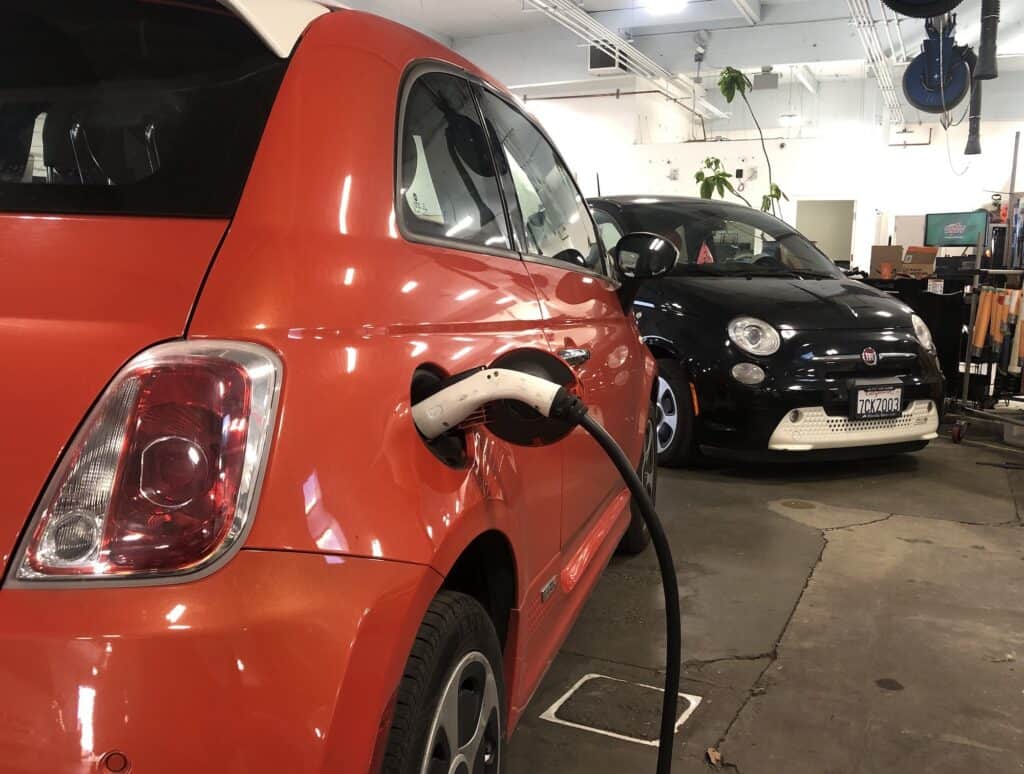
If you own a Fiat 500e, you already know the experience. It’s nimble, efficient, genuinely fun to drive, and a relief on San Francisco streets where parking is a competitive sport. You’ve also probably noticed that when something goes wrong, a lot of shops say they’re not familiar with the car.
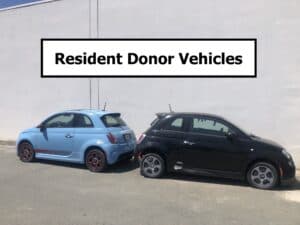
Over the last several years, the Fiat 500e has become one of the vehicles we see most often. Our Shop-Ware records show 217 repair orders on Fiat 500 EVs to date, with that count growing every month. Along the way we’ve acquired two dedicated donor vehicles for parts, invested in the Mopar Diagnostic Pod Plus (MDP+) with WiTech factory scan tool access, and built up enough pattern recognition on these cars to feel reasonably confident about most of what walks in the door.
Here’s what we’ve observed.
Routine maintenance: what we standardize
The 500e has a pretty straightforward EV maintenance profile, so we’ve settled on an approach.
Every visit starts with a courtesy inspection — tire tread and pressure (35 psi front and rear per Stellantis), brake pad thickness, brake fluid moisture, cabin air filter condition, and a full scan of onboard systems for stored fault codes. We also check HV battery state of health and individual cell voltages so owners get a real picture of where their pack is.
Brake fluid service tends to get overlooked. We’ve performed brake fluid service 17 times across our 500e ROs, which is actually low relative to how often the car needs it — Stellantis recommends every two years or 20,000 miles, and moisture absorption degrades braking performance over time. If yours hasn’t been done recently, it’s worth asking about.
12V battery replacement is one of the more frequent things we do on the 500e — 16 replacements logged in our records. Like other EVs, the 500e relies on a small 12V battery to wake the high-voltage system. When the 12V is weak, you can get a cascade of confusing fault codes and a car that won’t ready up, even if the HV pack is in great shape. We test the 12V at every service.
Tires are another regular item. The 500e uses an unusual 185/55R15 size, and the staggered wheel widths mean front-to-rear rotation isn’t possible — so the tires wear independently. We keep these in mind on every visit and can advise on the best options for Bay Area driving.
Common Fiat 500e repairs we see
After 217 ROs, a few patterns have emerged. The table below shows the repairs that come up most often on these cars in our shop.
A few of these warrant more context.
Park pawl actuator (P1626 / P1832)
The park pawl motor — the electromechanical assembly that locks the transmission into “Park” — appears to be one of the higher-failure components on this car. Symptoms we see include a blinking PRND indicator, the car refusing to shift into or out of Park, and fault codes P1626 (Park Pawl Motor Stuck) or P1832 (Shift Module Motor Overcurrent).
We source replacement units from a professional rebuilder, with a two-year warranty on the rebuild. We keep one on hand and core the old unit out when the next affected vehicle comes in. After doing this repair a dozen-plus times, we know what to expect.
Wheel speed sensors
We see wheel speed sensor faults often enough that they’re tied with 12V battery replacement as our most frequent repair on these cars. They usually present as an illuminated ABS, RSC, or ESC warning light. Rust and debris around the sensor and tone ring is a common contributing factor in the Bay Area’s coastal environment. Our process: scan, road-test with live sensor data on the scope, inspect the tone rings with a borescope, then clean or replace as warranted. Rear sensors fail more often than front in our data.
Onboard charging module (OBCM)
The 500e’s onboard charger — the module that converts AC to DC for the HV battery — is a known soft spot on these cars. We’ve handled three OBCM replacements in Shop-Ware, and have learned something useful from them: not all replacement OBCMs are equivalent.
Stellantis issued an internal technical service bulletin (STAR Case #S1408000106 from 06/02/2014) identifying specific part numbers (suffix AF and AG) as defective or obsolete. When sourcing a replacement, we specifically look for units with the updated suffix AH (P/N 05185004AH). When possible we pull these from our donor vehicles and bench-verify before installation. This is the kind of detail that’s easy to miss without reps on the specific car.
Charge port
The charge port assembly is more involved than it looks. It’s an integrated wiring assembly running from the rear of the car to the front, and replacement requires dropping the HV battery. We’ve completed four of these. Sourcing has been a challenge as Stellantis has phased out OEM parts, and we’ve used quality used components from our donor inventory to get owners back on the road.
Humidity sensor (B11FA00)
Fault code B11FA00 (Humidity Sensor Internal) comes up occasionally — three logged repairs in our data. The cabin humidity sensor sometimes fails or loses connection. Not a high-volume issue, but a quick, recognizable one when it appears.
Where factory tooling actually matters
Some of the harder 500e repairs need more than a generic scan tool. We made the investment in factory-level programming to avoid hitting a wall mid-job.
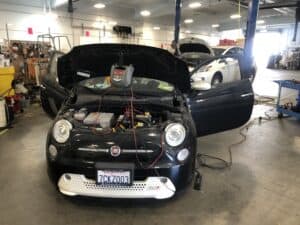
The Mopar Diagnostic Pod Plus (MDP+) gives us access to the WiTech factory scan tool and the Stellantis Mopar Service Library — the same diagnostic environment and service information used at Fiat/Chrysler dealerships. In practical terms, this means we can program replacement control modules, perform factory initialization procedures after component replacement, execute Stellantis TSB software updates, calibrate the regen brake controller, and work from Stellantis’s own wiring diagrams and theory-of-operation documents for the HV architecture.
For HV battery diagnostics, we read individual cell voltages, monitor cell deviation, check state of health, and verify battery pack control module (BPCM) communication. Codes like P1E25 (Hybrid/EV Battery Failure Level 2) and P0A1F (Battery Energy Control Module Internal Performance) take systematic, pinpoint testing — grounds, power circuits, CAN integrity, wake-up signal voltages — not guesswork or parts swapping.
For the inverter (one replacement so far), the procedure involves coolant bleed and refill, resolver offset learning, and post-repair fault verification. It’s a significant job but a defined one when you have the right reference material.
For wiring harness work — which Stellantis has discontinued many parts for — we sometimes locate the break and repair the existing harness, or harvest a known-good harness from one of our donor cars. Three of these jobs are documented in our records. It’s patient work, but on a car this fundamentally serviceable, we think it’s worth doing.
For the most demanding cases, we don’t work alone. We’ve built relationships with remote EV diagnostic specialists and other independent shops with deep EV expertise. On one extended no-charge/no-ready case, our founder Carolyn spent months working through Stellantis Theory of Operation documentation and scoping CAN bus signals with outside specialists before resolving the issue. That kind of case is rare, but the network is there when it’s needed.
The parts challenge
The honest picture on Fiat 500e parts: Stellantis has discontinued a meaningful number of components, and several of our calls to Fiat have been answered with “that part hasn’t been available since 2023.”
Our response has been concrete. We’ve acquired two dedicated Fiat 500e donor vehicles specifically to keep our customers’ cars on the road. Between them we maintain in-house supply of known-good used components — OBCMs, inverters, wiring harnesses, park pawl actuators, charge port assemblies — usually at a fraction of new OEM cost, when new OEM can even be found. We also maintain relationships with independent parts vendors and specialized suppliers for cases where our donor inventory doesn’t cover what we need.
It’s not the standard model for a service shop. We think it makes sense for this specific car, given how many of these are still on Bay Area roads and how usable they remain with the right support.
Schedule your Fiat 500e service at Earthling Automotive
The Fiat 500e community in San Francisco is small, enthusiastic, and — based on what we see — committed to keeping these cars running. With the right maintenance, the right tooling, and access to parts, they have years of practical life ahead of them.
If your 500e has a warning light, a charging issue, a parking pawl complaint, or just needs its routine EV service, we’d be glad to take a look. We document every visit through Shop-Ware with photos, notes, and full repair records you can access online anytime.
Book online at earthlingauto.com, or call or text us at (415) 875-9030.
Earthling Automotive | 615 Bayshore Blvd, San Francisco, CA 94124 | Monday–Friday, 8am–5pm